.webp)

Why Does Stress Make GLP-1s Stop Working?
Stress eating overrides GLP-1 medications because the two systems operate on entirely different biological circuits.
GLP-1s suppress physical appetite through gut-brain signaling. Chronic stress activates a cortisol-driven survival response that is older, faster, and louder than any pharmaceutical signal.
Understanding this distinction is not just useful. It is the difference between blaming the medication and actually fixing the problem.
When Life Does Not Pause
A doctor works 36-hour shifts with 8 hours off. For years, meals have been eaten standing up between patients, sleep comes in fragments, and stress never fully switches off.
When colleagues warn that health will give out, the first instinct is to step away from medicine entirely, get healthy properly, and return once things are calm. The problem is that life does not pause while that plan runs.
The situation is extreme. But the logic is familiar. Work spills over. The family needs something. A difficult month becomes two. And for anyone on a GLP-1 whose progress stalls the moment something hard arrives, that stall is rarely about the medication. It is about a biological system the medication was never built to reach.
What Do GLP-1 Medications Actually Do?
GLP-1 medications are genuinely remarkable in what they accomplish:
- They reduce the constant mental noise around food
- They slow digestion and improve blood sugar regulation
- They lower cardiovascular risk
- They suppress physical appetite through gut-brain signaling
For many people, the relief is immediate. Food stops feeling urgent. The compulsion quiets.
What GLP-1s do not do is touch stress. They do not interrupt the chain that connects a difficult emotional state to the act of eating. When chronic stress arrives, the medication is still working. What activates alongside it is an older, far more urgent system entirely.
What Actually Happens in the Body Under Stress?
Stress eating is not a sign of weak willpower. It is the body's stress response doing exactly what it was designed to do.
When the brain senses a threat, whether real or psychological, it triggers a cascade that ends with cortisol flooding the bloodstream. In the short term, this is useful. Cortisol sharpens focus and mobilizes stored energy.
The problem is that this system evolved for short, physical threats, not the chronic, low-grade pressure of modern life. A difficult performance review, financial uncertainty, a relationship under strain. These do not resolve in minutes. The cortisol keeps coming.
Chronically elevated cortisol does several things at once:
- Increases cravings specifically for calorie-dense, high-fat, high-sugar foods
- Promotes fat storage around the abdomen
- Breaks down muscle tissue
- Disrupts sleep, which makes hunger signals harder to read the next day
- Amplifies the brain's reward response to food, making comfort eating feel necessary at precisely the moment self-control is most depleted
Research consistently identifies psychological stress as one of the strongest predictors of weight regain after loss. This is not a motivation problem. It is a well-documented biological cascade.
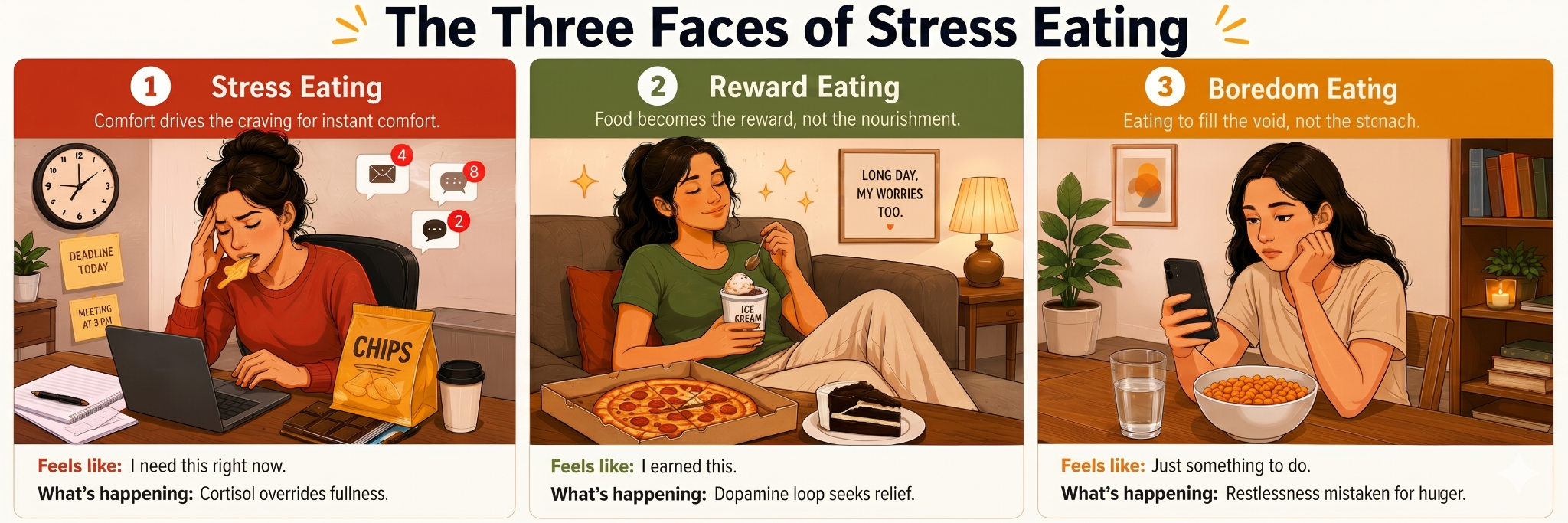
What Are the Three Ways Stress Shows Up at the Table?
Not all emotional eating looks the same. But it tends to come from the same source.
- Stress eating is the most direct expression of cortisol at work. The craving for dense, rewarding food in those moments is not a preference. It is a hormonal instruction. The GLP-1's appetite-suppressing effects are no match for a significant cortisol spike.
- Reward eating works through the brain's dopamine system, shaped over years of associating food with comfort and relief. The end of a hard day, a moment of professional disappointment, the quiet accumulation of too many demands. These trigger the brain to reach for food as a familiar resolution. The person is not physically hungry. They are completing a transaction the brain learned to make long before the prescription was written.
- Boredom eating is the most underestimated of the three. It arises from a low-grade restlessness that most people have never learned to sit with. Without specific practice in reading the body's signals, it is nearly indistinguishable from physical hunger. The GLP-1 quiets the physical signal. The psychological one continues underneath.
Where Does This Leave Someone on a GLP-1?
The medication opens a window. Cortisol does not knock before it climbs through it. Recognizing stress eating as biology rather than failure is not an excuse. It is the only productive starting point for what comes next.
If your progress on a GLP-1 has stalled during a difficult period, ask yourself honestly: was the medication failing, or was the cortisol simply louder?
%20(1).avif)
%20(1).avif)
%20(1).avif)
Ready to Transform Your Health?
.avif)